Nazirite Vow
Don't Leave God Alone: How to Get God's Attention, Remain in His Presence, and Even Change His Mind to Make a Difference in Your WorldThe Nazirite Vow is a covenantal pattern of consecration, dedication, and purity before God, illustrated most forcefully through Samson. Its decisive significance in the book is that spiritual strength is linked not merely to a gift received from God but to the disciplined protection of one’s commitment. Samson begins as a Nazirite from his mother’s womb, endowed with supernatural strength to defeat the enemy, yet his gradual compromises show how liberty can deteriorate into bondage. At the same time, his final refusal to surrender hope presents the possibility that failure need not be the end of a consecrated life.
Meaning and Spiritual Purpose
The vow marks a person as specially devoted to God. In Samson’s case, being a Nazirite from his mother’s womb means that his life was set apart through consecration, dedication, and purity before the Lord. The book treats this calling as more than a religious label: it is a way of living that preserves spiritual strength and keeps a person available for God’s purposes.
The vow’s logic is reinforced by the book’s broader teaching about daily righteousness. Lasting change is said to grow from repeated “seed decisions” involving right living, right thinking, right attitudes, and right choices. Consecration therefore operates through ordinary decisions as well as dramatic acts of faith. Repentance is not merely repeated regret; it requires a change of direction that eventually produces visible fruit. In this framework, the Nazirite Vow represents sustained self-government under God rather than a single emotional commitment.
Samson’s Gradual Compromise
Samson’s decline begins in Timnath, whose name is explained through concordances as meaning “portion, allotment, or allotted portion.” The book interprets this location as the stage at which a person feels conviction about questionable choices but continues along the same course. Timnath thus becomes the first sign of a moral progression: the warning is present, but it is not allowed to redirect the person.
From Timnath, Samson goes to Gaza, a city associated with the meaning “the strong.” Because he ignores his early convictions and compromises anyway, the place becomes an image of the stronghold that eventually binds him. His movement is not described as an instantaneous collapse. It is a worsening sequence in which small concessions make later captivity more likely.
Samson also begins breaking his vows regularly and lying about the violations. The repeated breach matters because it transforms compromise from an isolated failure into a pattern. His conduct creates the appearance that his consecration can be maintained outwardly while being abandoned in practice. The book’s warning is consequently directed not only at open rebellion but also at the self-deception that allows a person to call continued compromise faithfulness.
Loss of Strength and Captivity
The final compromise comes through Delilah, a harlot whose involvement removes Samson from the path of consecration. As a consequence, Samson loses both his anointing and his strength. The supernatural capacity given to him for defeating the enemy is not treated as independent of his spiritual condition; the loss of dedication leaves him vulnerable to the very powers he had been equipped to overcome.
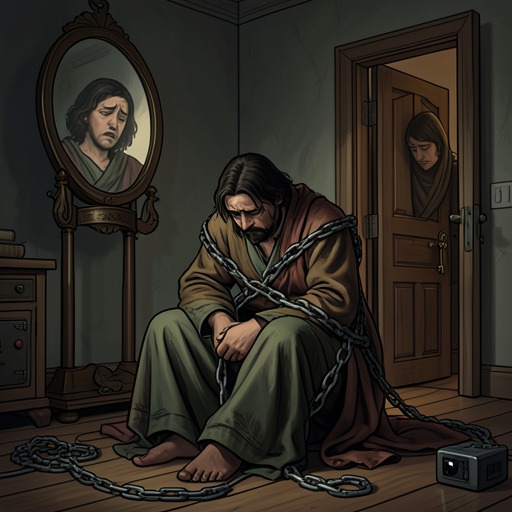
The Philistines, interpreted in the book as representing demonic spirits, bind Samson in chains and put out his eyes. His physical blindness becomes a picture of spiritual blindness, while the chains embody the stronghold produced by accumulated compromise. The road that began with ignored conviction ends in visible captivity. Samson’s condition also illustrates the danger of allowing sin to create distance from God. Elsewhere, the book compares self-protective excuses to fig leaves: human efforts at righteousness cannot replace honest return to God or provide a true covering before His presence.
Samson’s captivity is publicly humiliating. The Philistines bring him to a celebration of his defeat so that everyone can laugh at his bondage and blindness. The scene turns private failure into public spectacle and shows the enemy’s purpose as the book understands it: not merely to restrain a person, but to display the ruin of someone who once carried strength.
Failure, Repentance, and Hope
Despite the depth of Samson’s failure, he does not give up. He becomes determined to correct what he has done wrong, and the book states that God honored this determination. The response does not erase the consequences of the broken vow: Samson has already lost his strength, his anointing, and his sight, and he remains in chains. Yet his renewed resolve demonstrates that restoration begins when a person stops defending failure and turns again toward God.
This movement parallels the book’s instruction that people who have failed should not hide behind their own “fig leaves.” Because of the blood of Jesus, they are urged to run back to God rather than retreat in shame. The same principle appears in prayer: Adam and Eve hid after sin, but those who fail are told to approach God, ask forgiveness, and refuse to let guilt permanently separate them from Him.
The Nazirite pattern therefore contains both discipline and mercy. Its discipline warns that consecration must be guarded through daily choices, purity, and obedience. Its mercy insists that failure does not require permanent abandonment. Samson’s story makes the tension concrete: a sacred calling can be squandered through repeated compromise, but a fallen person can still turn back with determination and find that God responds to genuine correction.
Wider Pattern of Consecrated Persistence
The book connects Nazirite faithfulness with a larger discipline of refusing to leave God alone in prayer, worship, and obedience. Persistent prayer is described as bold, shameless, determined, and pressing; the desired attitude is not passive resignation but continued approach to God. The same persistence appears in Moses, who intercedes for the Israelites and tells God not to destroy them, insisting that God remember His agreement with His people. His appeal is presented as changing God’s mind and preventing judgment.
Consecration also requires honest repentance rather than religious appearance. A person who skips prayer or becomes absorbed in life’s distractions may begin constructing a figurative covering of excuses, but the remedy is continued return to God. The vow’s purity is thus not perfection without failure; it is a refusal to make failure a permanent identity.
Finally, the book places the Nazirite Vow beside a theology of authoritative faith. The angel speaks to Zechariah with the victorious challenge, “Who art thou, O great mountain? before Zerubbabel thou shalt become a plain,” and concludes with “Grace, grace unto it.” Elijah likewise declares that drought will come “according to my word,” and the book treats the later prophetic rain after months of drought as a confirmation of such faith-filled speech. These examples do not replace purity; they show the kind of spiritual authority the book believes consecrated people are meant to exercise. In this reading, the Nazirite Vow protects the vessel through which strength, prayer, repentance, and victorious speech are to operate.